
BOULDER, Colo. & OSLO, Norway: 3LC, the data-quality platform for computer vision and physical AI, today announced the launch of 3LC Hub, a browser-based, no-code entry point to its platform, along with Insights, the first analysis plugin in the Hub catalog.
3LC is built on per-sample, per-epoch metrics. As a model trains, the platform records how it responds to every individual sample on every epoch, capturing losses, predictions, embeddings, and any custom metrics a team defines. This produces a view that aggregate scores cannot: which samples taught the model, which held it back, which it never learned, and how far each moved in embedding space before it settled.
The Python API and the Dashboard remain central. The Python API gives data scientists programmatic control over building tables, defining custom metrics and collectors, weighting samplers, scripting revisions, and exporting. The Dashboard is where deeper work happens. A team can accept thousands of predictions as ground truth against an IoU threshold, create a new class for those that do not fit, and commit the result as a lightweight sparse revision with full lineage. No copy of the dataset is made, and no data leaves the customer’s infrastructure.
Insights: an automated analyst for your data
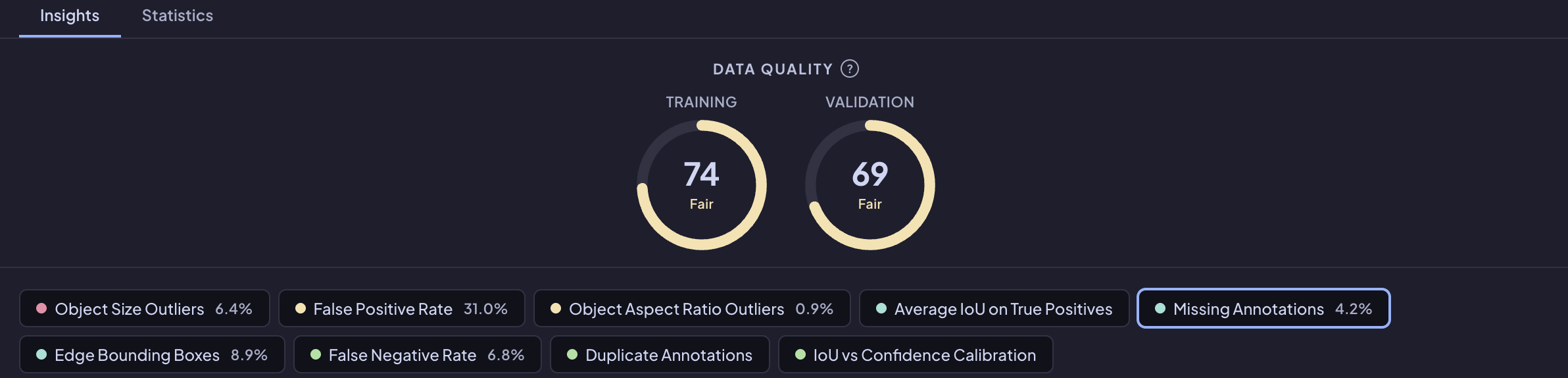
The Insights plugin shortens the path to that work. Run it after training and it reports where the model struggles and why: missing annotations, likely label errors, duplicated bounding boxes, class imbalance, confidently wrong predictions, and dozens of other checks across classification, detection, segmentation, and pose. Findings are ranked by severity, written in plain language with a recommendation, and presented with a health score. Each Insight opens straight into the Dashboard as a guided, pre-filtered view, where the correction can be quickly verified by a human and applied to the whole batch at once. Run comparison then shows what the fix bought, and whether it was the data edit, rather than hyperparameters or luck, that moved the metric.
The whole loop, in the browser
The Hub puts the whole loop in front of the entire team. Projects, datasets, and training runs sit in one view, with live charts for comparing runs. Importing, splitting, training, auto-labeling, and analyzing are one-click tools, and the Dashboard is accessible from any run or table. Work that used to run through a notebook now runs in the browser and returns results immediately. Domain experts and labelers can work in the same place as the data scientists, because no code stands in the way. The Hub layers on top of what teams already have, so there is nothing to migrate, and the full Python API is untouched. The browser talks directly to services on the customer’s own machines, which means deployments run inside a customer’s cloud tenancy, on-premises, or fully air-gapped.
Every capability is a plugin

Starting today, new 3LC functionality and new models arrive as plugins. They install from the catalog in one click, load without a restart, and run in their own isolated environment, and their results come back as ordinary 3LC runs with embeddings and per-sample metrics included.
The plugin SDK, a project template, and 3LC’s own plugins are public on GitHub at github.com/3lc-ai, including SAM3 auto-labeling, YOLO training, and TIMM training. Teams can build their own plugins and workflows against the Hub, then publish them internally through the same catalog. An engineer who builds a tool for one project can put it in front of the whole organization in days, inside the governance the organization already has.
Our customers could always see exactly what their model did with every image. The Hub is about how many people on the team can look and make the iteration faster and easier, and Insights is about knowing where to look first.
Paul Endresen, CEO, 3LC
Availability
The Hub and the Insights plugin are available today. The Dashboard, Hub, and Insights are included in every 3LC license.
About 3LC
3LC (3lc.ai) provides a data-centric platform for analyzing, debugging, and improving computer vision datasets and models. The platform enables organizations to identify hidden data issues, optimize labeling workflows, and accelerate machine learning development across complex real-world environments.


